9. Social media and public presence

Social media is woven into everyday life in the UK: community notices move on to Facebook groups, events are organised on Instagram, and public debate happens in comment threads. Even if you are careful, some exposure is unavoidable because other people can post about you, tag you, or upload images you appear in. The goal is not to disappear, but to understand how visibility is created and how to shape it in practical, realistic ways.
Managing unavoidable exposure
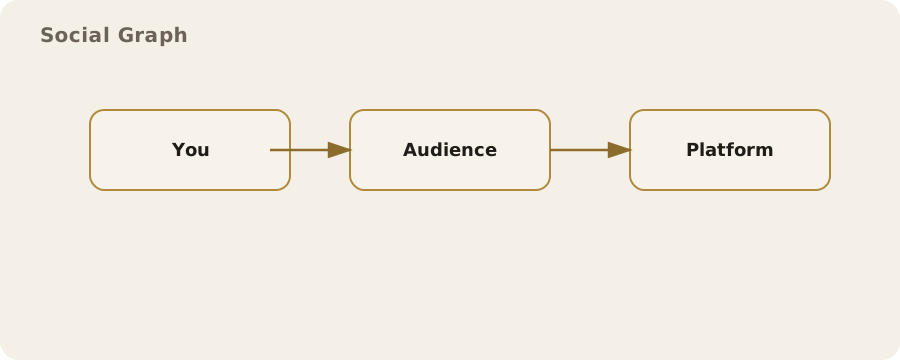
A public presence is the sum of what you post, what others post about you, and what platforms infer. The third part is often overlooked. Platforms build profiles from behaviour: what you watch, pause on, click, or ignore. That profile is used to decide what is shown to you and to others, and it is also used for advertising and content ranking. You cannot fully control these inferences, but you can control how much fuel you provide.
In the UK context, public posts are often treated as fair game for scrutiny by employers, journalists, or the public. Private communication is protected by law, but “private” in a social platform usually means “restricted by settings”, not “hidden from the operator” or immune from leaks. The practical question is less about legality and more about how likely information is to spread beyond its intended audience.
Algorithmic amplification
Social platforms do not show content to everyone equally. They use ranking systems that amplify material predicted to generate engagement. “Engagement” means clicks, comments, shares, watch time, or reactions. This is why a casual remark can end up reaching thousands of people: the system is optimised to surface posts that trigger strong responses, not necessarily those that are accurate or fair.
A common misunderstanding is that you can reliably predict who will see a post based on your follower count. In reality, a post can travel far beyond your network if it fits the platform’s engagement patterns. For example, a local Facebook post about a park redesign may be picked up by people who frequently comment on planning issues, and then shared into wider community groups. A short video about a minor train delay can be promoted to commuters outside your city if they watch similar clips, and a sarcastic joke can be pulled into a larger political thread because it fits a trending topic.
This amplification is a risk when context matters. A post written for friends can be interpreted as a public statement if it escapes its original setting. The mitigation is not silence but framing: add context in the post itself, avoid ambiguity where it could be misread, and assume that any post could be copied out of its thread. If a post only makes sense to insiders, consider whether it belongs on a platform designed for mass distribution.
You can also reduce the likelihood of amplification by limiting the signals that ranking systems value. Avoid piling onto trending hashtags that you do not want to be associated with. Think twice before reacting to content designed to provoke a response. If you want to discuss something sensitive, use platforms where the default mode is small, bounded communities rather than public feeds.
Historical posts and reinterpretation
Social media platforms have long memories. A post that was routine years ago can be read very differently in a new climate. This is not always malicious: norms change, and what was once considered casual language can later be seen as exclusionary or unprofessional. The risk is not just reputational; historical posts can be used to infer current views, affiliations, or even suitability for employment.
People often assume that deleting an old post removes it from the record. Deletion helps, but it is not complete. Screenshots, cached pages, or re-posts can preserve material. Some platforms retain data internally even after removal, and data brokers may have captured it earlier. This does not mean deletion is pointless; it simply means it should be seen as risk reduction rather than total erasure.
Practical mitigation starts with periodic review. Most major platforms allow you to view posts by year and adjust visibility. A realistic approach is to focus on high-risk categories: posts about work, political opinions, personal disputes, or images of others. In the UK, employers can and do review public posts, and some sectors have formal expectations around public conduct. For private individuals, the most common impact is social rather than legal, but it can still be significant.
Another mitigation is to separate roles. If you use a platform for professional visibility, keep it clean and consistent, and reserve more personal discussion for smaller groups or messaging platforms. This is not about hiding; it is about recognising that different audiences interpret the same material differently.
Private groups and leaks
“Private” groups are often treated as safe spaces for candid conversation. In practice, their boundaries are porous. Members can take screenshots, copy messages, or forward content to others. Some groups are also indexed by the platform’s own search tools, meaning that their existence and activity can still be visible even if the content is hidden.
Leaks usually happen for ordinary reasons rather than sophisticated attacks. A disagreement escalates and someone shares screenshots to prove a point. A new member joins under a real name and later changes job, taking a screenshot to a different network. A group admin’s account is compromised and content is downloaded. These are common failure modes because the key weakness is social, not technical.
Mitigation here is about consent and expectations. Before sharing in a group, ask whether you would be comfortable if a screenshot appeared elsewhere. If the answer is no, keep the detail out or move to a more private channel such as a small, vetted chat group. When you are running a group, set clear norms: no screenshots without permission, no reposting, and no doxxing. This will not stop a determined leaker, but it reduces casual sharing and gives members a shared understanding of boundaries.
It is also worth knowing what your platform can do. Some services offer disappearing messages or restricted forwarding, but these features are not foolproof. They are best understood as friction, not guarantees.
Images, metadata and recognition
Images are rich with information beyond what is visible. A photo can include metadata such as time, location, device model, and sometimes a GPS coordinate. Modern phones often embed this data automatically. Uploading a photo to social media may strip some metadata, but not always, and the original file can still be shared by others.
There is also the matter of recognition. Facial recognition can match a face across different images, even if the person is not tagged. Some platforms use this to suggest tags; others use it in the background for moderation or advertising. The UK has legal and regulatory scrutiny over biometric data, but public use is widespread in practice. For an everyday example, a street festival photo uploaded by a local paper can be indexed and matched against other public images, creating a trail that links a person to a location at a specific time.
Practical mitigation begins before taking the photo. If location is sensitive, turn off location tagging in your camera app, or use a separate camera app that does not record GPS data. When sharing, use platform settings that limit who can view the image, and avoid posting photos in real time if the location matters. For group photos, ask consent before tagging and be aware that even if you do not tag, others might. If you are concerned about recognition, consider using images that do not clearly show faces, or use shots from behind or at a distance where identification is less likely.
A common myth is that blurring or placing a small sticker over a face always protects identity. It helps, but not reliably. Partial features, distinctive clothing, or the background can still identify someone, especially in small communities. This is a case where the risk can be reduced but not eliminated.
Minimising footprint without isolation
Reducing your social media footprint does not mean disengaging from public life. It means choosing what you share, how, and where. A pragmatic approach is to keep public profiles sparse but accurate. Use a profile image that is recognisable but not overly detailed, keep contact details minimal, and avoid unnecessary personal data such as birth dates or precise home locations.
One effective practice is to separate “public identity” content from personal documentation. For example, if you want to promote your work, keep that on a public profile and share daily life in a closed circle. If you want to stay in community groups, do so with a profile that contains only the information you are willing to be seen by strangers. This is common in UK local groups, where people use their real names but keep the profile otherwise limited.
Be cautious about connecting accounts across services. Linking a public Twitter or Instagram account to a private Facebook profile makes it easier for others to trace a full picture. Platforms often suggest connections based on phone numbers or contact lists, which can expose links you did not intend. Opt out of contact syncing where possible, and review privacy settings after major app updates, as defaults can change.
There is a trade-off between visibility and opportunity. A lower footprint may mean fewer professional or social openings, while a higher footprint can bring attention that is not always welcome. The key is to be deliberate: choose where you want to be discoverable and where you prefer to stay quiet. That choice will shift over time, and it is reasonable to revisit it rather than treat it as a one-time decision.