7. Communications and messaging
Messaging is where risk escalates fastest because it feels ordinary. A quick text to a partner, a voice note to a colleague, a photo shared with a friend — all are routine, all are recorded somewhere, and each leaves traces that can combine in unexpected ways. The choices here are not just about secrecy or openness; they are about how much information you are prepared to leak by default and how much friction you can live with to reduce it.
What actually travels when you send a message
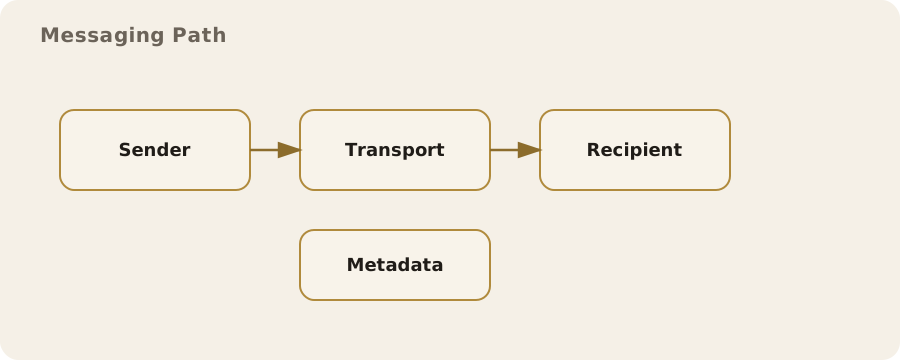
Most people think of a message as its content. In practice, every message also carries metadata: who contacted whom, when, from which device, using which network, and often with location signals attached. Even when the content is protected, the metadata usually remains visible to the service provider and, in some cases, to network operators. This matters because metadata is often enough to map relationships, routines, and patterns of life.
A mundane example: a community organiser sends a weekly reminder to the same list at 18:00 every Thursday. The content may be harmless, but the pattern reveals a regular group activity and the organiser’s role. In a workplace context, a manager’s late-night messages to a particular member of staff can signal a sensitive project even if the text is banal. These are not rare edge cases; they are the everyday results of communication systems that were designed for convenience rather than minimal exposure.
Encryption, and what it does and does not solve
Encryption is the process of turning readable text into a form that only a recipient with the right key can decode. The term “end-to-end encryption” means the message is encrypted on your device and decrypted only on the recipient’s device, not on the service’s servers. It protects content from the service provider and from many forms of interception, but it does not hide who you are talking to, when, or how often.
There is a common myth that “encrypted means anonymous”. It doesn’t. Another misconception is that encryption guarantees safety. It doesn’t, because the devices at each end remain points of failure. If someone has access to a device — a shared tablet, a work phone that is routinely checked, or a laptop infected with spyware — encryption of the transport layer is irrelevant.
In the UK, several mainstream messaging services offer end-to-end encryption by default. That is a positive baseline, but it is not the end of the story. Service providers can still collect metadata and can be compelled to hand it over. They can also be required to implement lawful intercept capabilities in ways that affect privacy. Most users do not need to become legal experts, but it is useful to know that the legal framework treats message content and metadata differently.
Choosing a channel: convenience, coverage, and control
Different channels offer different trade-offs. SMS is nearly universal and often treated as “just a text”, but it is unencrypted and vulnerable to interception and SIM-swap attacks. Standard email is often readable in transit and at rest unless both ends use additional encryption. Many popular messaging apps encrypt content but store backups in ways that remove those protections.
Consider a parent sharing a child’s medical appointment over SMS because it is quick and everyone has it. The risk is not only interception; it is that SMS is often tied to phone numbers that are used as identity markers for banks and services. If a number is taken over, old messages and authentication codes can be exposed at the same time. For this case, using a messaging app with end-to-end encryption and a local, device-only backup reduces the risk without asking anyone to learn a complex workflow.
For groups, convenience matters. If the only secure option is too hard to install, people will revert to the easiest channel and the group becomes brittle. A practical approach is to match the channel to the sensitivity of the topic, not to chase the “most secure” option for every situation. That means having a default choice for normal chat and a separate, clearly understood channel for higher-risk matters.
Device security: the weak link by default
Most real-world failures come from devices, not cryptography. A phone with a weak passcode, a laptop shared with family members, or a workplace device subject to routine monitoring can undermine all other safeguards. If a phone is unlocked at the moment a message arrives, any lock-screen notifications can expose content to bystanders. If message previews are shown on the screen, a casual glance on public transport can reveal more than you intended.
Simple mitigations are often more effective than exotic technical measures. Use a long passcode rather than a four-digit PIN. Disable message previews on lock screens for sensitive apps. Keep work and personal accounts separate where possible; mixing them can create legal and organisational risks, such as a work device being seized or inspected while containing personal correspondence.
It is also worth understanding how backups work. Many messaging apps offer cloud backups that are not end-to-end encrypted by default. This means your messages may be safely protected in transit but readable in storage by the provider or anyone with access to your cloud account. If you rely on cloud backups for convenience, treat them as a conscious trade-off, not an invisible default.
Contact lists and social graphs
When you install a messaging app, it often asks for access to your contacts. This can be a major privacy decision. Uploading your address book helps the service identify who you know, but it also exposes third-party data: you may be sharing other people’s details without their consent. It can also leak relationships that you did not intend to reveal.
A real scenario: a therapist installs a new messaging app to talk to clients and grants full contact access. The service now has a list that includes vulnerable individuals, professional peers, and personal contacts, all tied together. Even if the message content is encrypted, the contact graph is not. A safer approach is to deny address book access and add contacts manually when needed. It is slower, but it respects the privacy of others and reduces how much the service knows.
Groups, forwards, and the risk of drift
Group chats change risk dynamics. Messages that feel ephemeral can be saved, forwarded, or quoted out of context. Even in end-to-end encrypted groups, any member can capture content with screenshots or export functions. The technical protection stops at the group boundary; inside it, social dynamics take over.
Risk often escalates through drift — the gradual widening of who is in the group, or how its content is used. A neighbourhood watch group might start with a handful of residents and later include local officials or private security. The same jokes or casual remarks carry different consequences in a larger, less familiar audience. To mitigate this, treat group membership as a real boundary. Keep groups small for sensitive topics, use explicit names that reflect their purpose, and periodically review who is in them.
Voice and video calls
Voice and video calls feel more private, but the same rules apply. End-to-end encryption can protect the content of calls, yet metadata and call logs are still recorded. In some services, call logs are synced across devices or stored in cloud accounts. It is easy to forget that a call’s existence can be as revealing as its content, especially when patterns show who you speak to in moments of crisis or negotiation.
Background sounds and visual details can also leak information. The soundtrack of a call can reveal a workplace, a child’s school, or a public location. Video calls can show documents, screens, or household details in the background. Simple habits help: use headphones, check what is visible behind you, and avoid calls on speaker when others are present.
Disappearing messages and their limits
Many apps offer disappearing messages. These can be useful for reducing long-term exposure, but they are not a guarantee. A recipient can screenshot, photograph, or otherwise record content. Some apps notify you of screenshots, others do not. The feature is best seen as a tool for reducing the risk of later discovery, not as protection against the person you are messaging.
A concrete example: a journalist shares a sensitive source detail with a colleague using disappearing messages. This reduces the chance that a later device seizure reveals the text, but it does not prevent the colleague from taking a screenshot or copying the information elsewhere. The mitigation here is procedural: agree on how the information will be handled and confirm whether it should be written down at all.
When you should worry about telecommunications data
In the UK, telecommunications data — such as who contacted whom and when — can be accessed under legal powers that are broader than those for content. Most people will never be affected in a direct way, but the existence of these powers shapes the privacy environment. It is sensible to assume that if a message is important enough to matter, metadata might matter too.
This does not mean living in constant suspicion. It means understanding context. A community group arranging a picnic has a different risk profile from a whistleblower contacting a journalist. For the former, the convenience of mainstream tools may be a reasonable trade-off. For the latter, the risk of metadata exposure is a serious factor in choosing tools and in the timing and location of communications.
Identity, accounts, and phone numbers
Phone numbers are often treated as identities. They are used for account recovery, contact discovery, and multi-factor authentication. This convenience creates a single point of failure. If a phone number is reassigned or taken over through a SIM-swap, a chain of accounts can be compromised. This is not rare; it happens to ordinary people as well as public figures.
Mitigations are straightforward: set a carrier account PIN; avoid using SMS for account recovery where possible; use app-based authentication instead. For messaging, consider services that allow usernames rather than phone numbers, or that permit number hiding. These choices reduce how easily your communications can be linked to your broader digital identity.
Bridging work and personal life
Workplace communication tools often come with monitoring, compliance, or retention policies. Messages on work platforms can be retained for years and may be subject to audit. A message sent from a personal account to a work account can end up in systems you do not control. This is not about wrongdoing; it is about understanding how organisations manage risk.
In everyday terms: sending a sensitive personal update to a colleague via the company chat may feel private, but it can be archived and later retrieved as part of a routine compliance review. The mitigation is simple: keep personal communications on personal platforms, and use work systems for work. If you need to discuss sensitive matters with colleagues, agree on an appropriate channel that respects both individual privacy and organisational obligations.
Operational habits that make a real difference
Small changes in behaviour can reduce exposure without turning daily life into a technical project. A few examples that hold up in practice:
- Keep a small set of trusted, well-understood apps rather than juggling multiple services with overlapping functions.
- Turn on automatic updates so messaging apps and devices receive security fixes promptly.
- Use a separate device or profile for high-sensitivity communications if your normal device is frequently shared or monitored.
- Agree with regular contacts on which topics belong in which channels.
None of these guarantees safety, and they do not need to be pursued to an extreme. The aim is to lower the easy risks — the ones that arise from defaults, convenience, and assumptions — while accepting that some exposure is the price of normal communication.
Knowing when to accept risk
Every mitigation has a cost: complexity, time, social friction, or inconvenience. There is no single right level of protection. For many people, the most sensible approach is to keep everyday messaging simple and reserve extra steps for moments that justify them. For others, such as those working in sensitive roles or under greater scrutiny, a higher baseline may be appropriate.
What matters is clarity. If you understand what a tool protects and what it does not, you can make informed decisions without anxiety. Communication systems are not neutral; they embody trade-offs. Treat those trade-offs with the same care you would give to where you store your keys or how you lock your front door, and you will be better placed to live with the limits as well as the protections.