17.3 Government digital ID

Status reviewed 15 July 2026. The national digital ID is an active government proposal following consultation, not an identity document people are currently required to hold. The consultation says there would be no legal obligation to have or present it and alternative proofs would remain. Digital right-to-work checking is intended to become mandatory by the end of the Parliament, but the government says a passport or eVisa could be used instead of the national ID.
What is being built
The United Kingdom has no general requirement to carry an identity document. The Identity Cards Act 2006 scheme was repealed in 2010 and its National Identity Register destroyed. The current programme is not the same scheme: it is being designed around a digital credential held in the GOV.UK Wallet and checked electronically, with the government promising that possession remains optional. The historical comparison is still useful, but it should not be used to erase those legal and architectural differences.
The pieces already here
Several components already exist or are in development. GOV.UK One Login provides sign-in and, for some services, identity checking. GOV.UK Wallet is being built to hold government-issued credentials on a phone, with private testing of a digital driving licence reported in 2026. Separately, the Data (Use and Access) Act 2025 created a statutory framework for registered digital verification services. These systems can interact, but they are not interchangeable: a login account, a wallet, a government credential, and a private verification provider perform different functions and may process different data.
The national proposal and what is mandatory
The Cabinet Office consultation published on 10 March 2026 proposes a national digital ID with name, date of birth, nationality or residency information, and a photograph, held in GOV.UK Wallet and verified programmatically when presented. The consultation closed on 5 May and was followed by a People's Panel ending in June. At this review date the formal government response had not yet been published, so design details and legislation remain unsettled.
The proposal contains two statements that must be read together. First, the government says people will not be legally required to obtain or present the national digital ID, existing routes to public services will remain, police will receive no new power to demand it for ordinary stop and search, and suitable alternative proofs will continue. Second, it intends digital right-to-work checks to be required by the end of the Parliament. The March materials say that an employer could complete that digital check using the national ID, a passport, or an eVisa. The process may therefore become digital and mandatory without this particular credential becoming compulsory.
That position is more limited than the previous proposal was often reported to be, and the distinction is important. It does not remove legitimate questions about whether an optional credential becomes practically difficult to refuse, which services will accept alternatives on equal terms, how programmatic checks are logged, or how use expands. Those are governance risks to test against the eventual legislation and implementation, not facts already established.
The case made for it
It is only fair to state the case in its strongest form. A reliable digital identity could make many interactions genuinely easier: proving your age without revealing your name, accessing services without repeated form-filling, reducing certain kinds of fraud, and replacing the awkward business of posting copies of passports to landlords and employers. Proponents argue that people already hand identity data to dozens of private companies with far weaker safeguards than a government scheme would have, and that a well-designed state system using modern, privacy-preserving cryptography could reveal less, not more, than the status quo. Several other countries operate digital identity schemes that are popular and broadly trusted.
These arguments are not empty, and a flat refusal to engage with them weakens the case for caution. The right response is not to deny that digital identity could be done well, but to ask hard questions about whether this scheme, with this governance, these safeguards, and this trajectory, actually will be — and to insist that the burden of proof lies with those building a system that is difficult to dismantle once in place.
Why it worries people
Function creep
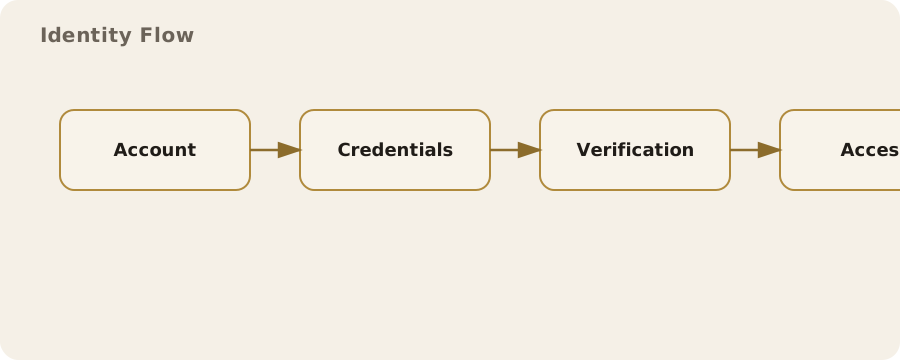
The first and most consistent concern is function creep: the tendency of a system built for one purpose to acquire others. A credential introduced to prove the right to work is easy to extend to renting a home, opening an account, accessing healthcare, claiming benefits, proving age online, or boarding transport. Each extension is individually defensible and administratively convenient. The end state, reached without any single decisive vote, is a society in which one government credential is the key to ordinary participation — and in which not having it, or having it suspended, becomes a serious disability. History shows that identity systems rarely shrink in scope; they grow.
A single point of failure
Concentrating identity functions can concentrate risk even if the wallet does not hold a single central copy of every underlying record. A widely accepted credential is a valuable target, as are issuance, recovery, revocation, verification logs, devices, and relying-party integrations. Incorrect source records, account lockout, lost phones, and service outages can become serious if alternatives exist only on paper. The final design should therefore be judged on data minimisation, selective disclosure, separation of identifiers, offline and non-smartphone routes, correction and appeal, breach containment, and whether one relying party can correlate presentations made to another.
Exclusion and coercion
Digital identity raises exclusion and coercion questions even when formally optional. Not everyone has a compatible smartphone, reliable connectivity, stable documents, a fixed address, or the confidence to recover a credential. People facing homelessness, disability, poverty, immigration complexity, or domestic abuse may be harmed most by a digital-first process. The government consultation promises non-digital routes and alternatives; implementation should be measured by whether those routes are genuinely available, timely, and no more burdensome. A credential displayed on a phone also needs safeguards against an abusive partner, overbearing employer, fraudulent verifier, or official asking for more than is authorised.
What you can do
Until final policy and legislation exist, verify claims against the consultation and later government response. Do not treat the GOV.UK Wallet, One Login, private digital verification services, the national digital ID, and right-to-work checks as one database or one legal obligation. When choosing an optional digital route, ask what attributes are disclosed, whether a transaction identifier is reusable, who receives verification logs, how a lost phone is recovered, and what equivalent alternative exists.
Where a digital check is legally required, disclose only what that process requires and keep physical or independent recovery routes where available. Do not use a government credential as a universal login merely because a relying party offers it. Review wallet permissions and device security, and challenge a party that insists on the national ID where official policy says another suitable proof is accepted. Data-protection access and complaint routes are in 17.8.
Primary sources: the Cabinet Office March 2026 consultation, its full proposal, and the government digital-ID explainer.