16. Freedom of Speech in the Digital Age
What it means, where it applies, and how it erodes
Freedom of speech is not a single rule
In the UK, freedom of expression is a recognised right, but it is not absolute. It sits alongside other rights and duties: privacy, protection from harassment, public safety, and the prevention of crime. This balance matters more online because speech can travel further, faster, and with less context than it does in a room or on a street. The idea of “free speech” in a digital setting therefore depends on where you are speaking, who controls the space, and what laws apply.
In everyday life, most people’s online speech takes place on private platforms: social networks, forums, comment sections, app stores, game servers, and workplace tools. These are not public squares in a legal sense. They are privately owned spaces with their own rules, enforced by moderation teams and automated systems. You are not entitled to have any specific message hosted or amplified by a private service, and the service is not required to keep you as a user. This is a common misunderstanding. The ability to post on a platform is a permission, not a constitutional guarantee.
Where freedom of speech applies in practice
Freedom of expression is most directly relevant when the state intervenes. A local authority removing posters, a police request to take down a message, or a court order requiring deletion are state actions. Online, these often occur through legal processes aimed at platforms, hosting providers, or telecommunications companies rather than individuals. The effect is still the same for the speaker, but the route is different.
Outside state action, speech is governed by contracts and policies. A video platform can remove a clip for breach of its terms. A workplace can discipline an employee for posts that damage the organisation, even if the posts are lawful. A school can restrict communications on its systems for safeguarding reasons. These are not necessarily violations of free speech; they are the ordinary consequences of using someone else’s infrastructure.
Context matters. A message shared on a public social network may be treated differently from the same message in a private group chat, not because the content changes, but because the audience and the risk profile do. A private chat is not invisible, but it carries a different expectation and is often regulated by different rules and technical controls.
How digital systems reshape speech
The digital environment is not neutral. It is shaped by technical design, business incentives, and moderation systems. A platform may prioritise content that keeps people engaged. That creates a structural advantage for material that triggers strong reactions, including outrage and fear. Over time, this changes the kinds of speech that feel rewarded and the kinds that are visible.
Recommendation engines can be more influential than explicit censorship. If a platform quietly reduces the reach of a topic, a speaker is not silenced, but their ability to be heard shrinks. This is difficult to detect. Many platforms use ranking systems that are opaque by design, partly to prevent manipulation. The result is a form of soft power that is rarely transparent to the user.
Automated moderation is another layer. Large platforms use machine learning models to detect prohibited content at scale. These systems are fast and cheap, but they are imperfect. They tend to do well on obvious cases and poorly on context, irony, minority dialects, and artistic expression. A comedian’s clip that uses a slur as part of a critique may be removed in the same way as a clip that uses it to harass. Appeals exist, but they are often slow, and smaller platforms may not have them at all.
Everyday speech and the friction of identity
Speech online is tied to identity in ways that are new and messy. Even when a person uses a pseudonym, their behaviour can be linked through device identifiers, cookies, or account recovery details. This linkage can chill speech because it reduces the gap between the private self and the public post. People may self-censor because they fear professional consequences, harassment, or misinterpretation.
Consider a teacher who comments on a local council policy in a community Facebook group. The post is lawful and polite, but screenshots are shared in a parent forum. The school receives complaints, and the teacher is asked to remove the post. No law has been broken. The pressure comes from the visibility and persistence of online speech, plus the ability for others to extract it from its original context.
The technical design of platforms amplifies this effect. Screenshots, reposts, and algorithmic resurfacing make it easy for speech to reappear long after it was posted. This creates a permanent record in practice, even when content is deleted. The risk is not only legal; it is reputational, professional, and social.
Common myths and misunderstandings
One myth is that if speech is legal, it must be allowed everywhere. In reality, legality and platform policy are different layers. Another is that anonymity guarantees safety. It does not. Pseudonyms can be linked to real identities through mistakes, data breaches, or platform logs. The more services you use, the more opportunities there are for linkage.
There is also a belief that moderation is purely political. In practice, moderation decisions are often driven by legal risk, advertiser demands, and the blunt limits of automation. This does not make the decisions neutral, but it does explain why enforcement can feel inconsistent or arbitrary. A post removed for “hate speech” might be the result of a keyword filter rather than a human judgment, and the same filter might miss more subtle abuse.
How speech erodes without anyone banning it
Erosion often comes from small frictions that accumulate. If posting leads to harassment, people stop posting. If a platform’s reporting tools are used to harass a group, their speech declines even if the platform never intended it. If users fear that jokes or casual remarks will be interpreted as misconduct by employers, they become more guarded. The net effect is a narrowing of public conversation without a single act of censorship.
Another driver is network dependence. When most public discussion happens on a small number of platforms, those platforms become gatekeepers. This concentrates power even when rules are not overtly political. A change in terms of service, a tweak to an algorithm, or a new advertiser policy can reshape what is visible overnight.
Finally, there is the quiet effect of surveillance. When people expect their communications to be logged, stored, or monitored, they behave differently. This does not require a hostile environment. Even in stable democracies, the knowledge that a message might be retained for years can discourage experimentation, dissent, or the exploration of unpopular ideas.
Risks, trade-offs, and how to manage them
There are real risks to unmoderated speech. Harassment, misinformation, and incitement are not abstract problems. Platforms that remove little content can become hostile or unusable, especially for marginalised groups. The trade-off is that aggressive moderation can suppress lawful and valuable speech. The goal is not perfect safety or absolute openness; it is a tolerable balance for a given community.
Design choices matter. Communities that grow slowly, with clear rules and visible moderation, tend to support more diverse speech than those that rely on automated policing alone. Tools that allow users to filter, mute, or limit replies can reduce harm without silencing others. However, these tools shift responsibility onto individuals and can create fragmented conversations where people talk past each other.
At the personal level, practical mitigations include separating identities for different contexts, reviewing privacy settings, and understanding who can see posts by default. These are not foolproof. They reduce risk but do not eliminate it. A private account can still leak, and a pseudonym can still be linked. The aim is to make unintentional exposure less likely, not to guarantee anonymity.
For organisations, clear and proportionate social media policies reduce harm. Overly strict policies can deter legitimate discussion and damage trust. Vague policies create uncertainty and a culture of caution. A well-scoped policy recognises that staff are citizens with opinions while clarifying genuine risks, such as disclosure of confidential information or harassment of colleagues.
UK context: rights, limits, and uncertainty
In the UK, freedom of expression is protected under the Human Rights Act, but it is balanced against other lawful restrictions. Laws on harassment, malicious communications, and public order can apply to online speech. So can defamation and contempt of court. The practical point is that online speech is not outside the legal system. It is subject to the same categories of lawful restriction as offline speech, but the consequences can be broader because the reach is larger.
At the same time, the UK has a strong tradition of debate and satire. That cultural context shapes how speech is interpreted by communities and institutions. A comment that is seen as legitimate political criticism in one community may be treated as harassment in another. Because online spaces are cross-cultural, these interpretations can collide.
There is also uncertainty. Legal thresholds are not always clear in the moment, and platform policies can be stricter than the law. This means that people often make decisions about what to say without a reliable map of the boundaries. In practice, this encourages cautious speech, particularly for those with more to lose.
Everyday scenarios that show the stakes
A local journalist reports on a planning dispute and receives targeted abuse. The platform’s automated tools remove some of the worst messages, but many remain. The journalist limits comments, which reduces abuse but also reduces public participation. The story is still published, but the conversation around it becomes smaller and less representative.
A community organiser uses a messaging app to coordinate volunteers. The group assumes it is private, but a participant shares screenshots with a rival campaign. The organiser tightens access and stops posting drafts for review. The group becomes more efficient, but the collaborative, open discussion that helped build trust fades.
A teenager posts a satirical meme about a public figure. It is reported as hate speech by people who dislike the figure, triggering a takedown. An appeal restores the post days later, but the account is penalised and reach reduced. The experience teaches the teenager that visibility is fragile and that the rules are not always predictable.
What durable freedom of speech looks like online
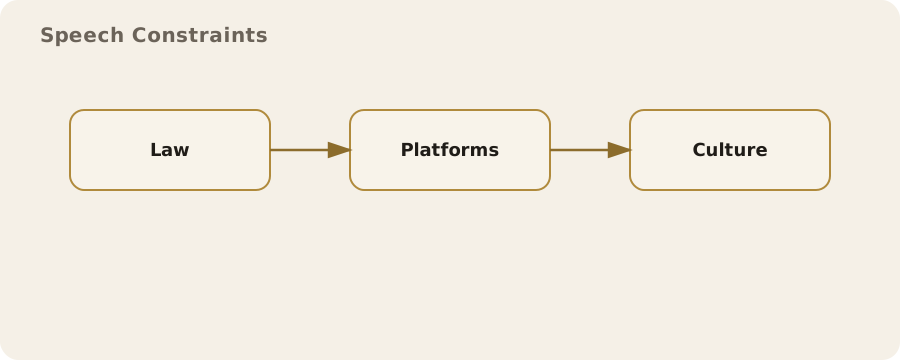
In practice, durable freedom of speech online looks less like a single rule and more like a set of conditions. It requires legal protections against state overreach, transparent and accountable platform policies, and social norms that tolerate disagreement without resorting to abuse. It also requires technical systems that are designed to handle scale without flattening nuance.
That combination is hard to achieve, and it does not eliminate conflict. It does, however, make conflict manageable and keeps the space open to a broader range of voices. The alternative is not usually outright censorship; it is a slow narrowing of what feels safe to say. Understanding that dynamic helps people make informed choices about where and how they speak, and what trade-offs they accept.