16.13 Protest, anonymity and public-order law
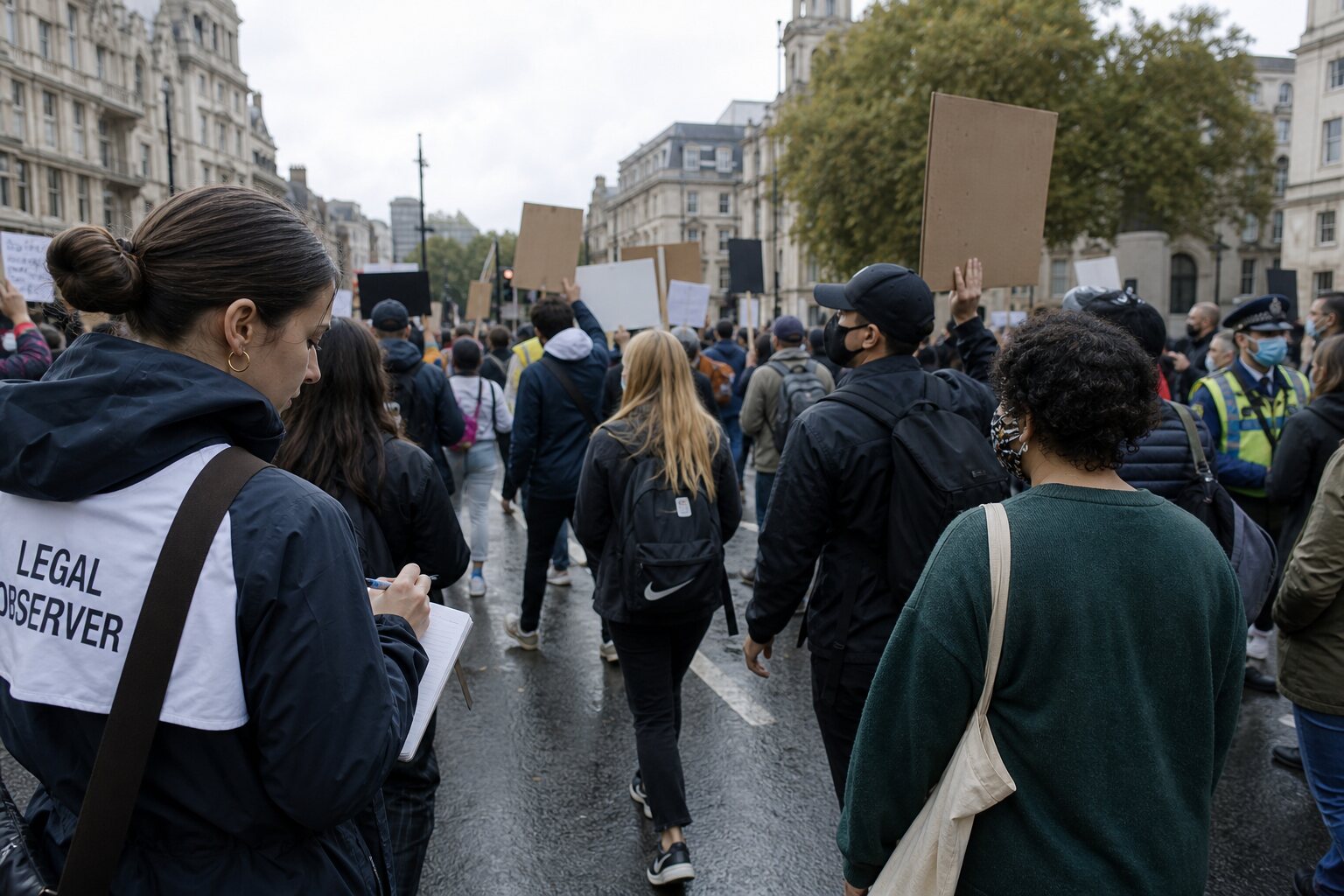
Status reviewed 15 July 2026. The new provisions described below came into force on 29 June 2026 and principally concern England and Wales. Scotland and Northern Ireland have different public-order law. This page is general information, not advice for a live protest, arrest, charge, or injunction.
Rights and limits
Articles 10 and 11 of the European Convention protect freedom of expression and peaceful assembly. Public authorities must act compatibly with those rights, and restrictions must have a legal basis and be necessary and proportionate. The rights do not immunise violence, criminal damage, intimidation, harassment, or every form of disruption. Nor do they prevent police imposing lawful conditions under public-order legislation.
The legal effect of a protest depends on facts that a short guide cannot resolve: whether an event is a procession, assembly, or one-person protest; what an organiser knew; whether a condition was validly made and communicated; the location and cumulative impact; the words or conduct used; and whether a statutory defence or reasonable excuse applies. Peaceful and unpopular expression can be protected even when it causes offence. A label such as "protest" does not automatically protect otherwise criminal conduct, while a police direction is not automatically lawful merely because it was given.
What changed in 2026
Part 10 of the Crime and Policing Act 2026 added protest-specific offences and changed police powers. The Act received Royal Assent on 29 April and the Home Office's commencement circular says the relevant provisions came into force on 29 June 2026. These changes sit alongside the Public Order Acts of 1986 and 2023, harassment law, criminal damage, highway law, and other existing powers.
Concealing identity in a designated area
It is not a general offence to cover the face at every demonstration. Sections 157 to 159 create an offence where a person wears or otherwise uses an item to conceal their own or another person's identity in a locality that has been formally designated by an inspector or more senior officer. A designation depends on a reasonable belief that a protest is or may be taking place, that offences are likely to be or have been committed in connection with it, and that designation is expedient to prevent or control offending.
The designation is limited in place and time and must be publicised as the Act requires. The offence concerns use for concealment, not merely possession of a scarf or mask. Statutory exceptions cover health, religious observance, and work-related use, and the exact wording should be checked before relying on an exception. A person should not assume that ordinary anonymity practice overrides a live designation, or that an officer's informal statement necessarily supplies every element of the offence.
This is distinct from the older section 60AA power under the Criminal Justice and Public Order Act 1994, which permits directions to remove face coverings in specified circumstances. The 2026 Act creates a direct offence in a designated area rather than relying only on refusal to obey a removal direction.
Other new protest offences
Section 160 makes it an offence to possess a pyrotechnic article while taking part in a protest in a public place, subject to statutory defences including reasonable excuse and defined cultural, religious, or work uses. Section 161 creates an offence of climbing on the memorials specifically listed in Schedule 17, subject to listed defences. It is not a general prohibition on approaching or photographing every memorial.
Section 162 creates an offence concerning a protest outside or near a public office-holder's dwelling where the protest is connected with that office and is intended to represent to or persuade the office-holder about what they should or should not do, or should or should not have done. The provision covers specified elected and public roles and contains detailed elements and territorial limits. It should not be paraphrased as a ban on criticism of officials or on protest at public buildings.
Expanded police conditions
The 2026 Act amends sections 12 and 14 of the Public Order Act 1986 so that cumulative disruption from frequent protests can be considered when imposing conditions. It adds powers concerning protests near places of worship where access or religious activity may be intimidated, expands which senior officers can impose conditions, and extends selected powers to the British Transport Police and Ministry of Defence Police. It also broadens an existing power dealing with harassment at a person's home so past conduct can be within the protest's target.
Conditions can concern route, location, duration, numbers, or other conduct within the statutory power. Whether breaching a condition is an offence can depend on knowledge or what a person ought to have known. If attending an event, check organiser communications and visible police notices rather than assuming yesterday's route and conditions remain current.
Privacy at a protest
A public demonstration is a high-observation environment. Police cameras, local-authority CCTV, transport systems, journalists, livestreams, participants, opponents, facial-recognition deployments, vehicle records, mobile-network location, and social-media uploads can all create records. A face covering may reduce casual recognition but does not erase clothing, voice, gait, companions, travel, payment, device, or account links, and it may now be unlawful in a designated area when used to conceal identity.
Do not promise anonymity to another participant. Obtain consent before publishing a close portrait where practical, especially for children or vulnerable people, but understand that photography in public is not governed by one universal consent rule. Journalism, data protection, harassment, safeguarding, and platform rules can point in different directions. Blur or crop identifying details when identity adds nothing to the public-interest purpose.
Location sharing is often the easiest link to miss. Photographs can contain metadata; cloud photo services record time and account; shared calendars and Find My-style services may reveal attendance; ride, map, and payment histories create independent records. Minimise collection before the event rather than trying to delete a web of copies afterwards.
Phones, recording, and seizure
Recording police in public is not in itself a general offence, but recording must not obstruct an officer, breach a specific lawful restriction, harass a person, or expose protected information. Keep physical distance, do not interfere with an arrest, and preserve original files if the recording may be evidence. Livestreaming creates an immediate public copy but can reveal faces, tactics, locations, and bystanders before anyone can assess the harm.
Police powers to seize and search a phone depend on the legal basis and circumstances. Seizure of a device does not mean every proposed search, cloud download, or demand for a credential is automatically authorised. Conversely, encryption does not override a valid legal power: Part III of the Regulation of Investigatory Powers Act 2000 can support a properly authorised notice requiring disclosure of a key or intelligible data, with criminal penalties for non-compliance. Obtain a solicitor for an actual demand. Do not rely on a protest leaflet or this site to decide whether to answer, unlock, consent, or refuse.
For device preparation, the detailed controls in 4.4 apply. A strong passcode, current software, hidden notification previews, minimal cloud data, and an emergency contact are more dependable than a novelty "protest phone" that has not been updated or tested. Biometrics improve everyday theft resistance but may raise different coercion questions from a memorised passcode.
Practical preparation
- Check the organiser, route, assembly point, expected conditions, transport disruption, and legal-observer information before leaving.
- Carry only the data and accounts needed. Back up essential material, charge the phone, and bring a separate battery if appropriate.
- Write an emergency and solicitor contact on paper. Do not make the locked phone the only place that information exists.
- Use a strong passcode, conceal notification contents, disable unnecessary lock-screen replies and controls, and verify device-finding settings.
- Know whether a face-covering designation or other condition has been announced. Health and religious exceptions are fact-specific, not a general route around the law.
- Do not carry pyrotechnics or other items merely because another attendee says they are permitted. The person carrying an item bears the immediate risk.
- Separate witnessing from confrontation. Record from a safe position, note times and locations, and preserve originals without publishing vulnerable people reflexively.
- If arrested or given a formal demand, ask for legal advice and the legal basis. Do not obstruct, destroy evidence, or improvise a legal argument at the scene.
Sources and jurisdiction
The principal current sources are the Crime and Policing Act 2026, the Home Office commencement circular, and the Crown Prosecution Service protest-offences guidance. The Home Office circular itself states that it is not legal advice and is not a comprehensive statement of law; this summary has the same limitation.