13. Psychological resilience and sustainability

Privacy work is not only technical. It is a long game that sits alongside jobs, families, mental health, and the ordinary churn of modern life. The aim is to keep yourself safe and sane over years, not to win a single perfect day. This section is about the everyday psychology of living in a monitored world without slipping into collapse, obsession, or resignation.
Avoiding paranoia without ignoring reality
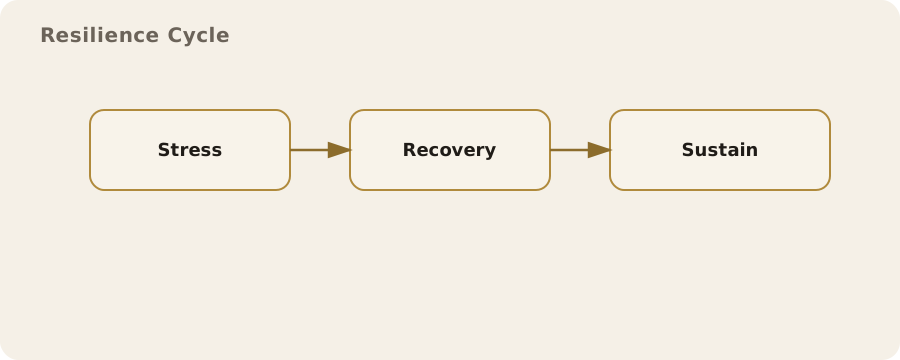
Paranoia is not the same as caution. Caution is a set of choices grounded in evidence and proportional risk. Paranoia is when every inconvenience feels like proof of a plot, or when the cost of a small mistake feels catastrophic. The difference matters because paranoia pushes people into brittle routines: too rigid to sustain, too exhausting to keep.
A practical approach starts with understanding your actual exposures. If you work in healthcare, finance, or public service, you may be dealing with regulated systems that are already monitored. If you are a journalist or organiser, your risks are higher, but still bounded. If you are an ordinary citizen, your day-to-day digital footprint is often collected for commercial reasons, not personalised surveillance. That commercial collection is still serious, but treating it as targeted persecution will burn you out.
A common misunderstanding is that privacy equals invisibility. In reality, it is about shaping what is collected, how long it persists, and who can reach it. A person using full-disk encryption on a laptop, secure messaging for sensitive chats, and an ad-blocking browser is not hiding from the state; they are reducing casual exposure and the blast radius of a device loss or account compromise. That framing keeps the response proportional and sustainable.
There is also a failure mode where people become suspicious of everyone. That is not only unpleasant, it is impractical. You still need colleagues, neighbours, service providers, and friends. Treating all of them as adversaries makes you more isolated and more likely to make mistakes. A better method is to separate trust in people from trust in systems. You can like your bank cashier and still avoid sending sensitive documents through unsecured email.
Accepting constraints without surrender
Some monitoring is structural. Public transport has CCTV. Many employers have network monitoring. Mobile networks log where your phone connects. In the UK, data retention and lawful access powers exist even if you never interact with law enforcement. You can reduce what is recorded and how widely it spreads, but you cannot delete the environment. Accepting that reality is not surrender; it is a starting point for sensible choices.
Constraints show up in mundane places. A workplace may require you to use managed devices. A school might demand a specific app for parents. A landlord could insist on email correspondence. The healthy response is to limit sensitive work to personal devices, keep work data on work systems, and avoid blending contexts. That separation is a boundary you can control even when the system is not under your control.
Another constraint is time. Privacy practices that require constant vigilance will fail. If a routine does not survive a bad week or a stressful month, it is not a routine, it is a sprint. Sustainable practices include choosing a password manager, enabling device encryption once, and making a habit of locking screens. These are low-friction changes that persist even when you are tired or distracted.
Private thought versus recorded thought
Recorded thought is anything externalised into a system: a note in a cloud app, a query typed into a search engine, a draft email left unsent. Private thought is what you keep internal or store in a way that is not passively synced. The difference matters because data that exists can be copied, leaked, misinterpreted, or recontextualised years later.
In practice, many people blur the line because it is convenient. They write sensitive reflections into default note apps, or vent in messaging threads that feel private. The risk is not always that someone is reading now; it is that a future incident, a device loss, or a platform change exposes a history you never intended to publish. The mitigation is to be deliberate about where you put your inner life. A paper notebook, a local text file inside an encrypted drive, or a private diary application with end-to-end encryption are practical ways to keep recorded thought controlled.
This does not mean you should never write. Writing helps people think. The goal is to choose the medium with awareness. If you are processing a difficult relationship issue, a private notebook may be safer and more emotionally honest. If you are collaborating on a project, a shared document might be appropriate, but keep personal reflections elsewhere. That boundary reduces the risk of emotional spillover into professional systems.
Offline trust and the limits of digital certainty
Digital systems are good at recording transactions and poor at reflecting intent. A screenshot can show a message, but not the context. Logs can show access, but not understanding. This is why offline trust remains central. Knowing people face to face, building a track record, and understanding their constraints is more reliable than any “verified” badge or online reputation.
Offline trust does not mean blind trust. It means using human relationships where machines are weak. For example, if you need to share a sensitive document with a solicitor, you might arrange a meeting and exchange a USB drive after confirming identity in person. That reduces exposure to phishing and account takeover. If you are coordinating a small community project, agreeing on decisions in person and then documenting the outcome online is safer than debating everything in a public group chat.
There is a common myth that encryption solves trust completely. Encryption protects content in transit and at rest, but it does not prove the other person is who you think they are. It also does not stop someone from sharing what you said once they receive it. That is a human problem, not a technical one. The mitigation is to combine strong channels with human checks: verify contact details through another route, meet when it matters, and avoid sharing more than necessary with people you do not truly know.
Disengagement as health, not defeat
Some privacy choices are about stepping back. You do not need to chase every tracking pixel or argue with every platform. Disengagement can be a deliberate health choice. It might mean deleting a social media account that makes you anxious, or deciding not to carry a smartphone on a weekend walk. These choices reduce data collection, but their primary benefit is often mental clarity.
Disengagement also has limits. Withdrawing completely can isolate you from work, services, or friends who rely on mainstream tools. The sustainable approach is selective withdrawal: keep the tools you genuinely need, and leave the rest. For example, you might keep a simple messaging app for family, but avoid social media feeds that pull you into endless scrolling. You might choose a feature phone for daily use while keeping a smartphone powered off at home for necessary apps.
There is a risk of making disengagement performative, where the effort to avoid monitoring becomes a constant project. That turns into a different kind of capture. A healthier pattern is to make a few decisive cuts, then stop thinking about them. Replace the time with something concrete: a hobby, exercise, or in-person conversation. The absence of data collection is not the point; the regained attention is.
Living with trade-offs over time
Every privacy choice is a trade-off between convenience, cost, and risk. Over time, the cost of maintaining complex systems becomes a risk in itself. It can lead to poor upkeep, forgotten passwords, or security shortcuts. Simpler, well-maintained systems are usually safer than elaborate setups you cannot sustain.
One practical approach is to schedule periodic check-ins rather than constant tweaking. For instance, a monthly review of accounts and device updates, and a six-month review of your most sensitive storage. This is not perfection, but it is steady. It also reduces anxiety because you have a place in your calendar for privacy maintenance, instead of keeping it in your head every day.
Finally, accept that you will sometimes choose convenience. That is not failure. It is a conscious trade-off. You might use a ride-hailing app because the alternative is walking through an unsafe area late at night. You might send a document by email because a secure portal is broken and a deadline matters. The important part is noticing the choice and understanding the exposure, not living in a state of constant guilt.