11. Behavioural discipline and human risk

The weakest link
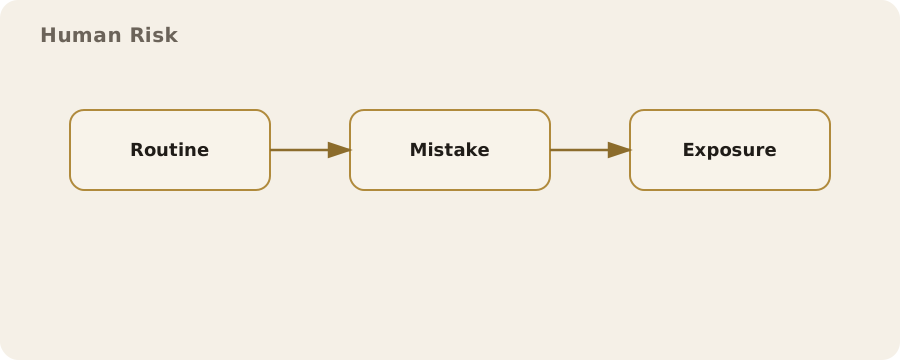
Security and privacy are often framed as a technical problem, yet the point of failure is just as often human behaviour. People make decisions under pressure, when tired, when angry, or when simply trying to be polite. In a monitored world, the most sophisticated toolset can be undone by a few careless minutes. This section looks at how ordinary behaviour creates risk, and how small adjustments reduce it without turning daily life into a performance.
Emotional posting
Emotional posting is not just about the content of a message, but about its timing, tone, and metadata. A late-night thread after a stressful day, a sharp reply in a public forum, or a heated comment under a local news story can reveal mood, routine, and relationships. Platforms log timestamps, IP addresses, device identifiers, and location hints. Even if a post is deleted, it may be cached, shared, or stored in platform logs under UK retention and compliance practices.
A real example: someone in Manchester argues with a local landlord on a community Facebook group. They post from their personal account, then later try to make a complaint through a tenant’s union using a different email address. The thread provides context, language patterns, and timing that can connect the identities. The problem is not a single angry post; it is the linkability of behaviour.
The common misunderstanding is that privacy is only about what is said. In practice, how and when it is said can matter as much. Mitigation here is behavioural: pause before posting, draft offline, or delay sending until emotions settle. For sensitive topics, shifting to private channels or using in-person conversations can reduce the data trail. These steps reduce risk but cannot remove it, because platforms and networks still see activity patterns. The trade-off is speed and immediacy versus the long-term cost of a permanent record.
Alcohol and fatigue
Alcohol and fatigue degrade judgement in ways that are predictable and measurable. People are more likely to reuse passwords, accept dubious links, and overshare in messages when tired or intoxicated. This is not a moral issue; it is a cognitive limitation. In everyday life it looks like agreeing to a rushed video call on an unfamiliar app, or replying to a workplace request without checking the sender’s address.
A common scenario is a night out: someone logs into a social account on a friend’s phone to show a photo and forgets to sign out. The phone later syncs the account, or the browser auto-fills other details. Another is late-night online shopping where a browser extension captures card details or a phishing site mimics a bank page closely enough to fool a tired user. In the UK, banks often rely on behavioural signals and device recognition; logging in from a new device late at night can trigger extra checks, but those checks do not guarantee safety.
Practical mitigation is simple: avoid account changes and sensitive conversations when impaired or exhausted. Use separate devices for social browsing and for authentication apps if possible. Turn on app-based two-factor authentication, which adds a small barrier when judgement is low. This reduces the chance of a single lapse causing a full account compromise. The risk cannot be eliminated, only reduced by habit.
Over-explaining
Over-explaining is a quiet risk. It often comes from a desire to be helpful or credible, but it gives away details that can be pieced together. In practice it appears as a long email to a support desk, a detailed complaint on a public forum, or a lengthy response to a journalist. Each extra detail adds a strand: where you were, who else was involved, what systems you use, and what you are worried about.
A practical example: someone reporting a bicycle theft includes the serial number, exact route home, the time they left a pub, and that they live alone. The police may need some of that, but posting it in a neighbourhood group creates an unintended profile. In workplace settings, an employee replying to a “security check” email with screenshots and internal system names can hand a phisher the map for a later attack.
A common myth is that more information always improves credibility. In reality, it improves the ability of others to link events and identify patterns. Mitigation is about being precise rather than exhaustive: answer the specific question, avoid unnecessary context, and move detailed exchanges to a channel with clear purpose and limited audience. This is a trade-off between speed of resolution and control of exposure. You cannot prevent all inference, but you can reduce the amount of raw material available.
Normality as camouflage
The idea of blending in is often misunderstood. “Normal” behaviour can act as camouflage, but only when it matches the context. In a workplace where everyone uses the same calendar system and logs in at similar times, a sudden switch to unusual tools or hours can draw attention. In contrast, in a creative community where people use a mix of messaging apps, a low-key presence is less conspicuous.
A real-world example is travel. Someone uses a privacy-focused browser at home but reverts to the default browser on a work laptop. That is normal within many organisations and does not stand out. If they instead use a bespoke secure OS on a loaned corporate device, they might trigger internal security reviews or questions from IT. The risk is not wrongdoing; it is that a divergence from the expected baseline becomes a topic of discussion or scrutiny.
Mitigation is to understand the baseline of the environment you are in and choose low-friction options within it. In UK contexts, employers can monitor corporate devices for legitimate business reasons; that monitoring is typically disclosed in policies. Staying within the normal tooling reduces the chance of attracting attention, but it does not guarantee privacy. The trade-off is between optimised privacy tools and the social and organisational signals those tools can emit.
Silence as strategy
Silence is not just saying nothing; it is choosing when not to respond, when not to post, and when to let a conversation end. In monitored environments, each reply creates data. A refusal to engage can be a practical way to reduce exposure, particularly with unsolicited requests, aggressive questioning, or social media baiting.
A concrete example: a message from an unknown number asks, “Is this still your number?” Replying confirms identity and keeps a thread alive. Ignoring it may feel impolite, but it avoids confirming data. Another example is workplace gossip on group chats: choosing not to react avoids creating a written record that might later be pulled into an HR investigation. Silence here is not a moral stance; it is data minimisation.
The misunderstanding is that silence looks suspicious. In many everyday contexts it is normal for people to ignore texts, delete messages, or leave conversations. The risk is situational: if you are already in a formal investigation, silence may carry different implications. Outside that context, not responding is usually a low-risk choice. The mitigation is to separate social relationships from operational conversations and to decide in advance where you will respond quickly and where you will not. The trade-off is social smoothness versus exposure. Some risk is simply accepted in the interests of ordinary life.
Designing habits that survive convenience
The behaviours described on this page have a common enemy, and it is not a hacker or an official — it is convenience over time. Almost anyone can be careful for a day. The difficulty is sustaining discipline across months and years, through tiredness, busy periods, and the small frictions that make the safe option feel like a chore. Relying on willpower to bridge that gap is the most common way good intentions quietly fail. The more durable approach is to design your setup so that the safe path is also the easy path, so that discipline is mostly a matter of how things are arranged rather than constant conscious effort.
In practice this means converting one-off decisions into defaults that hold even when your judgement is poor. Keeping separate accounts and devices for separate parts of your life, as set out in Chapter 8, means the right identity is used automatically rather than chosen correctly each time under pressure. Letting a password manager and multi-factor authentication carry the load, per 2.2, removes the temptation to cut corners when you are rushed. Turning off automatic uploads, setting messaging apps to delete old history by default, and removing the accounts and apps you no longer use all shrink the amount of raw material a single lapse can expose. The aim is a life where the careful choice happens by default and the careless one takes deliberate effort — the reverse of how most systems are configured out of the box.
This framing also keeps discipline sustainable rather than exhausting, which matters because security habits that depend on permanent vigilance tend to collapse, a point developed in Chapter 13. It is better to make a few structural changes once — changes that quietly protect you on your worst day — than to demand flawless behaviour from yourself every day. Human risk is never eliminated, because people remain people; but it is substantially reduced when the environment is arranged so that the easy, normal, low-effort thing is also the safe one. That, more than any single rule on this page, is what behavioural discipline looks like when it actually lasts.