Foundations and threat modelling

Before choosing tools, changing habits, or arguing about rights, it helps to understand what you are defending, who might want access to it, and what the real costs are. This is the foundation of privacy and security. It is also the foundation of sensible decisions about speech and personal freedom in a digitally monitored world.
What is a “threat model” in ordinary life?
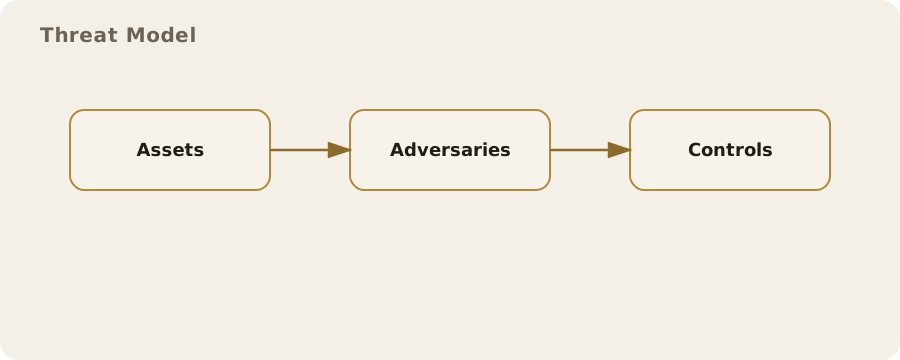
A threat model is a practical description of what could go wrong, how it could happen, and what you would lose if it did. It is not a list of worst‑case horrors. It is a way of matching protection to reality. For a small business owner, a data leak might mean losing customers and a fine from the Information Commissioner’s Office. For a teenager, it might mean a private photo turning up in a group chat. For a protest organiser, it might mean a phone seized and contacts exposed.
Threat modelling starts with three simple questions: What is valuable, who might want it, and how could they get it? In practice, “valuable” includes money, identity, health information, location history, political beliefs, and relationships. The “who” can be a criminal, a curious employer, a hostile family member, a marketing firm, or the state. The “how” can be obvious, like phishing emails, or subtle, like quietly collecting location data through apps.
Assets, adversaries, and your boundaries
An asset is anything you want to protect. Some assets are obvious: bank accounts, devices, and personal data. Others are more social: reputation, freedom to associate with others, the ability to speak without being profiled. These matter because they affect how people treat you, what opportunities you receive, and whether you feel safe expressing yourself.
Adversaries are people or organisations who could use access to those assets against you. They differ in motivation and capability. A scammer wants quick money and usually relies on low‑effort tricks. A stalker may know you well and can exploit shared accounts or family plans. A company may want to profile you for advertising or risk scoring. A state body may have lawful powers to request data, but those powers have limits and oversight.
Boundaries are the lines you decide not to cross. For example, you might accept that a fitness tracker records heart rate but reject sharing your precise location with third parties. You might accept being on public social media but draw the line at linking your real name to a pseudonymous account. These choices are not about paranoia; they are about personal values, safety, and the specific contexts you live in.
Context shapes risk
In the UK, the legal and cultural environment matters. Data protection law sets limits on how organisations can use personal data, and there are routes to complain. That does not mean data misuse never happens. The practical risk depends on the organisation’s competence, incentives, and the sensitivity of the data. A national health record is protected by strict rules, yet breaches still occur through human error.
Similarly, freedom of speech exists within a legal framework. It is possible to be legally within your rights and still face consequences at work or in social settings. It is also possible for lawful speech to be misinterpreted by automated moderation systems. Understanding this helps you set realistic boundaries: when to be public, when to be discreet, and when to avoid leaving searchable traces.
Threat modelling by example
Imagine a landlord who manages properties through online platforms and messaging apps. Their assets include tenant data, rent records, and their own bank accounts. Likely adversaries include phishing criminals and opportunistic scammers. The landlord’s realistic mitigations are strong account passwords, two‑factor authentication, and careful verification of payment changes. They do not need military‑grade security; they need to avoid common traps and reduce the impact of a mistake.
Now consider a nurse who uses a smartphone at work and at home. The assets include private conversations, family photos, and access to the hospital email system. The adversaries are not just criminals; there is also the risk of employer policies being enforced through device management tools. A practical boundary might be to keep work accounts on a separate profile or device, and to keep personal data backed up and encrypted.
Finally, consider a community organiser arranging a public meeting. The key assets are contact lists and the identity of vulnerable attendees. The main adversary may be public scrutiny rather than a criminal. Here, the mitigation might be using invitation‑only channels, avoiding unnecessary collection of personal details, and deciding when to use real names. The trade‑off is friction: extra effort can reduce attendance, so the organiser chooses a balanced approach.
Common misunderstandings that weaken security
One misunderstanding is that privacy is all‑or‑nothing. In reality, privacy is about degrees. You can reduce your exposure without disappearing from the internet. Another myth is that encryption makes you invisible. Encryption protects the content of a message, not the fact that it was sent. Metadata, such as who contacted whom and when, can still be highly revealing.
There is also the belief that only people “with something to hide” need privacy. That ignores the ordinary ways data can be misused: insurance pricing based on health assumptions, employers making decisions based on social media profiles, or data brokers selling location trails that reveal visits to clinics or support groups. Most people are not targets, but everyone can be affected.
Understanding how data moves
To make good choices, it helps to know where data flows. When you use an app, data typically moves from your device to the service provider, and often onward to analytics firms, advertisers, or partners. Some data is necessary for the service to work, such as a delivery address or payment details. Other data is optional but quietly collected because it is valuable to the business.
Data also persists. Messages can be backed up automatically to cloud services. Photos can contain embedded location information. Browsers and operating systems keep logs to make your life easier, but those logs can be accessed by anyone who gains access to the device or account. A useful mindset is to assume that most data you create will exist somewhere else, unless you deliberately prevent it.
Risk, friction, and the reality of trade‑offs
Every protective measure has a cost. Stronger security can mean more steps, fewer conveniences, or reduced compatibility. For instance, using two‑factor authentication makes account takeover much harder, but it adds a step when you sign in and can create trouble if you lose access to your phone. Using end‑to‑end encrypted messaging keeps content private from the service provider, but it can make backups and message search harder.
These trade‑offs are not failures; they are decisions. The aim is not perfect protection, which is unrealistic, but a balance that fits your life. For a journalist or activist, extra friction might be acceptable. For someone caring for relatives who need quick access to shared devices, it might not be.
Failure modes and how they show up
Security often fails in ordinary ways. Passwords are reused across sites. Security questions rely on information that can be found on social media. Devices are left unlocked at home or in workplaces because it feels safe. These failures are not always careless; they are the result of time pressure and the desire for convenience.
A realistic defence is to reduce the impact of the inevitable mistake. Unique passwords and a password manager limit the damage of a breach. Device lock screens limit casual access. Separating accounts, such as keeping banking on a different email from social media, can slow down attackers. None of these removes risk entirely, but they change the cost and likelihood of an attack.
Trust is part of the model
Much of digital life depends on trust. You trust a phone manufacturer not to ship spyware. You trust a cloud service not to misuse your files. You trust that a friend will not forward a private message. Some of this trust is reasonable. Some of it should be tested.
Testing trust does not require technical skills. It can be as simple as reading permissions before installing an app, checking whether a service provides clear privacy settings, or seeing whether a company has a track record of responding to breaches. In the UK, you can also check whether a company is registered with the Information Commissioner’s Office when they handle personal data. This does not guarantee good behaviour, but it signals a willingness to be accountable.
Setting a personal baseline
A practical baseline is a set of protections that are reasonable for most people. It might include keeping devices updated, using a password manager, enabling two‑factor authentication for important accounts, and backing up data in a way that does not expose it to unnecessary parties. It also includes knowing how to recover if something goes wrong, such as having recovery codes stored safely or knowing how to freeze a credit report if identity theft happens.
From this baseline, you can adjust based on your own threat model. If you travel frequently, you might choose to separate travel devices from home devices. If you are concerned about workplace monitoring, you might keep personal and work accounts apart and avoid using employer‑controlled devices for private matters. These are not extreme measures; they are ordinary ways of managing risk.
Freedom of speech and the cost of visibility
Speech is not only about legality. It is also about visibility, permanence, and audience. A private conversation in a messaging app is different from a public post, even if both are lawful. The risk is not just prosecution; it is misinterpretation, harassment, or employment consequences. These risks do not mean you should stay silent. They mean you should decide, consciously, where and how to speak.
Practical steps include using different identities for different contexts, avoiding unnecessary personal details in public discussions, and keeping records of your own speech when you expect disputes. These choices are as much about resilience as about security. They recognise that the digital public square is open, searchable, and often unkind.
Where to go next
The foundation is to know your assets, adversaries, and boundaries; to understand how data moves; and to accept that trade‑offs are real. From there, you can make deliberate choices about tools, habits, and the degree of visibility you want. This is not about perfection. It is about clarity.